
by Admin | Nov 27, 2022 | Blog
What is a Help Desk Service?
This Service includes technical support and customer assistance by phone, in person and remotely. This service is offered monthly or once. You can discuss the problems with the service team by email or chat and get the necessary guidance as soon as possible.
The main purpose of the Help Desk Service is to ensure customer satisfaction and the ability to operate any machine you may have a problem with.
What is an IT Help Desk?

IT Helper hire with the department Service and help their customers for computer, hardware, or software problems when a problem occurs. The IT Technician must have sufficient knowledge and awareness to interact with the customer and be able to understand the customer’s needs and solve their problems as quickly as possible.
They often receive the first contact from users based on chat, email, or phone call. An IT Technician is responsible for providing support, troubleshooting, or technical assistance. They interact with their customers to solve problems and help them to solve the problem.
What happened when you contacted the IT help desk?
At this stage, technicians get your issue with email, chat, or telephone and they process it, they will contact you for technical assistance by phone or email. They perform remote troubleshooting, through diagnostic techniques and related questions, and then provide the best solution based on the issue and details that customers have mentioned.
Some process examples for Help Desk Services
- Receive calls for customers seeking technical assistance via phone or email.
- Remote troubleshooting through diagnostic techniques and related questions.
- Providing solutions based on the topic and details provided.
- Help the customer to solve the problem.
What is Help desk software?
It is software that enables a company or an individual to support its customers in the shortest possible time.

by Admin | Nov 27, 2022 | Blog, Network Security
What is Network Security?

One of the main topics of computer networks is Network Security. After configuring and deploying the hardware, we must pay special attention to this topic. In this section, we will examine the following:
- What is computer network security?
- Wireless networks
- Firewall
What is computer network security?
It includes things like software used, data stored, and information theft. Everything that is used in a computer network system (both software and hardware) must be protected against attacks and risks.
Three principal factors are needed in the security of a computer network, these three factors (CIA) are the basic principles of information-security in information storage and exchange environments.

- Confidentiality
- integrity
- Availability
Confidentiality:
That is, the information should be available only to those who need it. For example, leaving part of a company’s confidential file

Integrity:
- Just authorized persons or instructions can change system
- authorized people or processes cannot change system without permission and without reason,
- It is necessary to maintain the integrity of information inside and outside the system, and it must be the same inside and outside the system, and if the information changes, they must be aware of it both inside and outside the system.
Availability:
Information should always be available and able to do its job, and there should never be a factor that disrupts the system’s work. For example, if the power goes out and we don’t have a solution for it, this system is not safe.

There are many concepts in the discussion of network security, which can be mentioned as these basic concepts:

- Identification: requesting identification when the user accesses the system,
- Authentication: specifying the user’s identity
- Authorization: the level of user access to resources.
- Accountability: ability to audit system performance
If you are interested in seeing some learning, you can click here.
by Admin | Nov 26, 2022 | Blog, Windows Server
What is a Server?

In fact, we call a supercomputer or a computer with extremely performance as a server, so it is a computer or a program that can provides services to the programs installed on the user’s computer or another computer.
It can refer to a physical machine, virtual machine, or software that performs services. We can use them for various purposes, we can change according to our needs.
What Types we have?
Servers can be divided into physical and virtual

Physical: like a physical computer, but it works much more powerfully and is used to run server software.
Virtual: is software that runs on a host, and we can adjust the amount of memory, processor and change all its elements. If you want to know more about virtual servers, you can read this post.
Their hardware usually performs much more complex tasks with a higher traffic load, so hardware manufacturers design them to support more additional components, for example, additional power supplies, additional network interfaces, and more memory ports allow it to continue working if one of them fails.
The design of their hardware is usually different from the hardware of a desktop.
Manufacturers are designing Desktop computers in the form of small towers and to place under the table, but usually some manufacturers design to lie flat too.
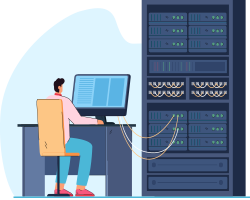
However, some manufacturers still offer tower servers, but most of manufacturers are designing to mount on the rack.
Some examples of different:
- WebServer: You interact with a variety of internet servers because you see this page, or download, or upload an app.
- EmailServer: If you have Gmail or Yahoo, you are using an email server to access your email account.
- PrintServer: It can manage print files and printers and can control them.
- GameServer: To load an online video game, you must connect to the server. Each game can have its Own Server.
- ProxyServer: we can filter content, increase the speed, prevent unauthorized users, and ensure the safety of data.
- VideoServer: Netflix and YouTube are using a video server and these servers can store Movies and TV shows as data.

Suggested services for their maintenance:
- Managed Services include monitoring and reporting
- Remote and on-site server remediation services
